
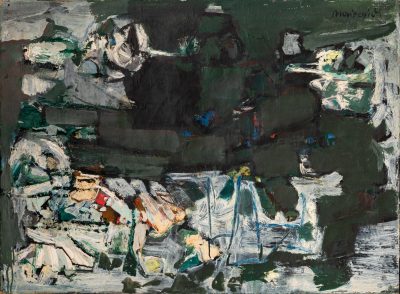
The Negev Museum of Art is honored to present the exhibition Sudden Landscapes, dedicated to the desertscape paintings of the artist Zvi Mairovich (1911–1974) – a member of Ofakim Hadashim and one of the fathers of abstraction in Israel.vi (Hersh) Mairovich (Meirovitch) was born in Korsano, Galicia, into a religious Jewish family, but under the influence of the Haskalah Movement, he abandoned religion in his youth. When he was 18, his father sent him to rabbinical school at the Higher Institute for Jewish Studies in Berlin, but he soon quit the school and took up painting classes under Karl Hoper at the Academy of Fine Arts. In 1934, he fled Nazi Germany and immigrated to Pre-State Israel, where he settled in Haifa and became a part of the local art scene. Mairovich was one of the founders of the Haifa Artists Group, participated in the Painters and Sculptors Association’s shows, won the Dizengoff Prize for Art (1942, 1950, 1961) and the Hermann Struck Prize (1948), participated in the Exhibition of the Eight and the Exhibition of the Seven, and in 1948 co-founded Ofakim Hadashim (“New Horizons”) and was one of the group’s leaders (until his secession in 1959). From then on, Mairovich’s paintings started to shift towards abstraction: figures, still lifes, and landscapes were gradually stripped of their characteristics, and their distinct forms took a back seat to pictorial values and expressive style.
Mairovich’s desertscape paintings, which he dubbed “the landscapes of Sodom,” are widely considered one of the pinnacles of his oeuvre. They were created in the early 1960s, during the artist’s desert visits, mainly in Mitzpe Ramon and the Dead Sea area. Indeed, the features of the place were translated into the color palette of these paintings, which included: red (earth, the rose-red mountains of Edom/to the east), white (salt, wind), ochre-browns (sand, khmasin, light), black (shade), and purples and greens (minerals, oxidized iron).
Here, in front of the primordial views of the desert, Mairovich reached the highest level of abstraction his paintings achieved up to that point, as he described it: “Here I am painting nature. Here, the desire to return to the primal sensation of seeing. Then comes the whirlwind. And the reduction, and a certain something. The cruelty of the restriction stems from the silent persistence of nature. An immutable thing imposes its essence upon it. The landscape of Sodom. A deserted, purplish-red, sudden, incomprehensible landscape. It’s hard to imagine something more primal and more new.”
The experience of the desert and the observation of nature’s presence and absence served Mairovich as a springboard towards a higher level of abstraction than ever before, and no less than that, to realize his desire to merge the universal values of abstract painting with the local values of the place’s features. “I don’t want to exaggerate,” concluded Mairovich: “But then something happens. Something that’s alive takes shape from the living. The canvas takes a life of its own.”
Curator: Ron Bartos