Current Exhibition

Yaara Oren: Quilt05.11.2025 - 28.02.2026

Current Exhibition

Eran Webber: Embodiment05.11.2025 - 28.02.2026

Current Exhibition

Ronit Porat: Night Forest05.11.2025 - 28.02.2026
Current Exhibition
Yaara Oren: Quilt

Yaara Oren: Quilt

Curator: Ron Bartos

Assistant curator: Dr. Lia Moran Gilad

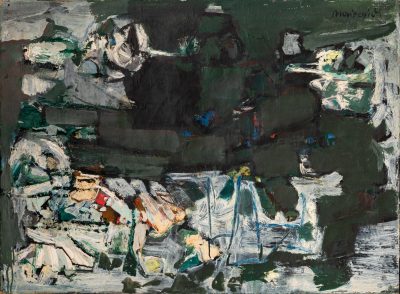
The Negev Museum of Art is proud to present Quilt – the first museum exhibition by artist Yaara Oren. A painter and ceramic artist, over the last decade Oren (b. 1982) has formulated a cohesive artistic language that is simultaneously personal and universal, consistent and versatile, while drawing on the values ​​of abstract painting.

As abstract as it may appear, in the process of its formulation, Yaara Oren’s painting acquires footholds in reality. In some instances, these are landscape views, a window frame, or an architectural element. Other times, the painting will anchor itself in an image like a bird, moon, or child, and sometimes it will hold on to a sign such as a letter or word. For instance, in the painting Plants, featured in the exhibition, Oren incorporated the profile of a slumbering child whose head can just be glimpsed from under the blanket – a patchwork quilt that is in fact a surface in hues of blue, “woven together” until it spreads across the entire painting. The quilt that covers the child corresponds with Oren’s painting practice: a patchwork that joins fields of color and covers the pictorial expanse.

Despite its distinctly abstract nature, Oren’s work lets go of abstraction’s autonomous mandate, enmeshing itself with the world beyond it. Throughout the various chapters of her work, time after time Oren chooses to validate the link between the signifier (the painting) and the signified (the world), not in order to describe or represent, but to use the simple signifiers as a means for carrying complex signifieds. In other words: like a Trojan horse or a strawberry-flavored medicine, Oren’s painting uses the closeness generated by a familiar image as well as the rich and seductive color palette as a means that can carry additional elements, which do not amount to representation or description – complex signifieds.

Look at the paintings and observe the pictorial values: tonal ​​(saturation, lightness-darkness), proportional (detail-whole), compositional (structure-stability), tactile (textures), dynamic (movement and energy), musical (harmony and dissonance), organic (flow-growth), as well as intuitive (expression of inner experience) and psychological (emotional activation). All of these add up to create paintings that encourage a direct, non-symbolic, and humanly accessible experiential perception, which juxtaposes the aesthetic domain with the quotidian. Oren emphasizes the sensory and emotional aspects over the representational or symbolic aspects. The sense of humanity lies in the complex, soft, and elusive signified, which needs the language of abstraction in order to find expression. And indeed, if asked, she will confirm that her work strives to facilitate an aesthetic encounter that conjures a profound, subjective, and spiritual experience, one which looks towards the sublime.


Less
Current Exhibition
Eran Webber: Embodiment

Eran Webber: Embodiment

Curator: Ron Bartos

Assistant curator: Dr. Lia Moran Gilad

The Negev Museum of Art is proud to present Eran Webber: Embodiment, the first solo museum exhibition of Eran Webber – a virtuoso sculptor and one of the only artists in the local art scene who works in the spirit of classical figurative sculpture.

Webber (b. 1980) studied in Florence, Italy, first at the Academy of Fine Arts and later at the Florence Academy of Art (FAA), where he serves as a senior lecturer in sculpture. Upon his return to Israel in 2013, he founded the sculpture department at Hatahana Studio School in Tel Aviv as well as the Webber Atelier in Moshav Habonim – an independent sculpture workshop that also serves as his studio. Webber’s art, then, has deep roots in the traditions of sculpture, between classicism and early modernism. If we wanted to outline its characteristics, we could note that Webber’s sculpture is figurative and realistic; faithful to the language of naturalistic portrayal; exquisitely crafted in its finishes yet still divulges the touch of the artist’s hand on its surface; and reveals traces of romantic admiration and fascination with archetypes. However, the main focus of his expression is on the human soul and the emotional world of the individual, and how they are shaped by the unmediated impression that emerges during the life sculpting or drawing session.

The exhibition is dedicated to a two-year artistic chapter that centers around one significant sculpture – a sculpture that is a human anti-monument, a life-size portrait of a woman; a sculpture that captures the figure of Michal Yagel Alonim. Webber spent two years sculpting the likeness of his neighbor and friend Michal. Two years during which he sculpted her changing appearance and waning body, as she slowly succumbed to an incurable neurodegenerative disease (ALS). This is how the sculpture Michal, which is stands at the heart of the exhibition, came about, as well as the documentary May I Speak to You of Life by Gal and Maya Raveh – two complementary works that unfold a story about life and about parting from life.

The sculpture of Michal is shaped as a free-standing, upright sculpture. Michal’s focal points are her closed eyes and outstretched arms. Her facial features are at once relaxed and shrunken – both a death mask and a life mask. Michal’s body is half-naked and wrapped in fabric, whose folds were formed in the finest tradition of classicist drapery, evocative of a dress, a sheet, a shroud, or a cocoon. The choice of a cocoon is in fact a choice in metamorphosis, meaning, in change rather than loss, just like Webber’s choice in additive sculpting. This is a very significant decision that embodies a sculptural concept, since classical sculpture is often created through a process of removing material (e.g., carving in wood, chiseling in stone), and perhaps sculpting through subtraction (reduction and removal) would have been more fitting of Michal’s material likeness. However, therein lies a significant aspect of the sculpture’s essence, since additive sculpting means choosing change over giving up, forming over dismantling, affirmation over negation. In that sense, the sculpture Michal was created in an inverse relation to its subject matter: as Michal experienced more and more limitations, restricted movement, and loss of motor functions, the sculpture took on shape, transcended, gained volume, and crystalized.

Look at Michal’s arms and notice how she invites us to place our hands in her delicate hands. In contrast to the inward gaze intimated by her closed eyes, her arms seek an external expression and contact with another body – to ask or provide help, to offer solace. The sculptor continues to believe that it is still possible, perhaps more so now – to recognize and even establish ourselves by recognizing the other, by holding hands, as an echo of the words “Your hands made me and fashioned me.”


Less
Current Exhibition
Ronit Porat: Night Forest

Ronit Porat: Night Wood

Curator: Ron Bartos

Assistant curator: Dr. Lia Moran Gilad

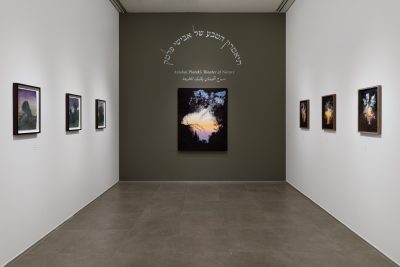
The Negev Museum of Art is proud to present the exhibition Ronit Porat: Night Wood. Ronit Porat is a multidisciplinary artist who specializes in photographic collages, juxtaposing photos with archival, historical, artistic, and biographical materials that she extracts from their original context and sets in new ones. She applies the same practice to the exhibition before us, following a stream of consciousness that emanates from two separate springs. The first is the sculpture The Amazon (1915) by Chana Orloff (1888–1968) – an eminent sculptor and one of the central figures of the School of Paris. Orloff formulated a modernist language that infused avant-garde formal simplification with human warmth, and focused on the human figure, particularly women – artists and intellectuals whose portraits became representations of a new, modern femininity. The Amazon, which references the ancient myth of female warriors who lived outside male-dominated society, symbolized modern and independent femininity in the present tense and hinted at a deep kinship between women, manifested in shared inspiration and strength, like the sisterhood that formed around Orloff’s studio. The second point of departure, which also inspired the exhibition’s title, is the 1936 book Nightwood by Djuna Barnes (1892–1982). A masterpiece of 20th century literary modernism, the provocative book recounts a complicated, tragic, and passionate relationship between two women, set against the backdrop of love and loneliness in Paris’s dark nightlife between the two World Wars.

Porat’s Night Wood came about through the confluence of these two sources of inspiration. The artist turned to the visual raw materials – photographs, reproductions of sculptures, scans of art books and magazines of their period – and created (digital) collages in an act of crossbreeding images into hybrid photographs. And so, effectively this is not about creating something out of nothing, but rather about creating something out of something, which entails involvement and affinity. In a way, the raw materials allow Porat to take part in the culture of other times and places: She visits Orloff’s studio, immerses herself in the social circle that has formed around it, and intertwines her artistic language into the artistic languages ​​of those artists. And so, alongside the longing for Paris as a tumultuous and alluring cultural center, Porat’s works also take on another dimension: The collagist deconstruction and fragmentation respond to the instability that prevailed in Europe, to the rifts that began to emerge in that reality, on the verge of the great catastrophe.

Ronit Porat (b. 1975, Kfar Giladi) holds a BA in Photography and Digital Media from Hadassah College in Jerusalem and an MFA from the Chelsea School of Art and Design in London. Her work has been featured in numerous exhibitions in Israel and internationally and has won her the Artistic Encouragement Prize by the Ministry of Culture (2013) and The Lauren and Mitchell Presser Photography Award for a Young Israeli Artist from the Tel Aviv Museum of Art (2017), among others.


Less
The Negev Museum of Art We use cookies to ensure the website functions properly and improve user experience. You can choose which types of cookies to enable.
Cookie Selection